

Last Updated: November 4, 2026
Quick Summary
To identify durable cotton, check for long-staple fibers like Supima, Pima, or Egyptian, a fabric weight of 180 GSM and up, and combed or ring-spun yarn. Then confirm quality by testing seam recovery, fabric opacity, pilling risk, and shape retention, and by inspecting for double stitching and clean hems.
- Pinch, weigh, and crumple the fabric: heavier cotton with sharp creases that stay signals weaker fibers.
- Hold a single layer to a window; even opaque coverage means tighter construction than visible gaps.
- Rub fabric against itself about ten times to check pilling risk; combed or ring-spun cotton fuzzes less.
- For everyday tees, 180-220 GSM is the substantial, opaque range suited to durable cotton T-shirts.
- Turn garments inside out and look for double stitching, French seams, coverstitch hems, and taped shoulders.
Table of Contents
- How to Check Cotton Fabric Quality by Touch and Sight
- Long-Staple Cotton and Fiber Length: The Core of Durable Cotton
- Fabric Weight, GSM, and Density: What the Numbers Mean
- Yarn Quality and Fabric Construction: Woven vs Knit
- Seams, Hems, and Finishing Details That Signal Durability
- How to Tell If Clothing Is Good Quality Online
- Cotton Fabric Quality Chart: A Quick Reference
- Durable Cotton T-Shirts: Fit, Drape, and Everyday Use
- Frequently Asked Questions
How to Check Cotton Fabric Quality by Touch and Sight
You can judge a lot about durable cotton apparel in ten seconds with your hands and eyes. But touch and sight alone are subjective. Pair quick sensory checks with a few repeatable at-home tests for a more objective read on seam recovery, opacity, pilling risk, and shape retention.
Most people buy cotton on feel alone. Soft wins. But soft can be a trap: a brushed finish feels great in the store and pills within a month.
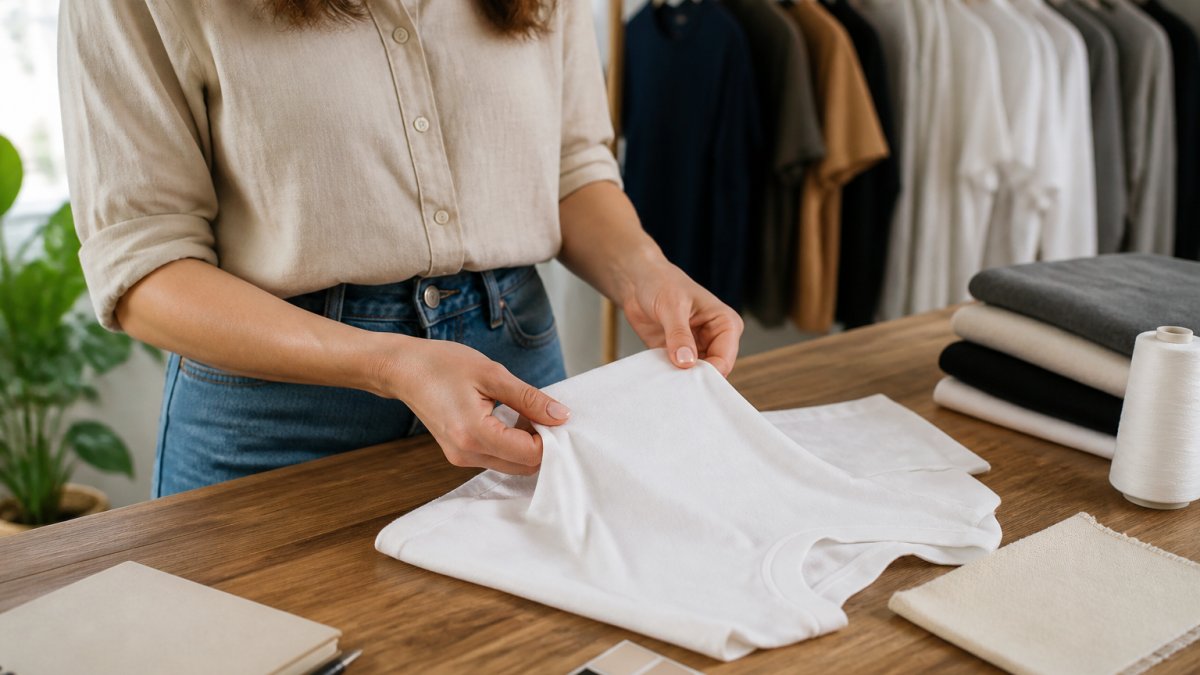
The Feel Test: Softness, Weight, and Hand
Hand feel is the term the trade uses for how fabric feels against skin. It covers softness, weight, and surface texture in one judgment. Use it as a first filter, not a final verdict.
Run these three checks:
- Pinch test: Pinch two layers and rub them. Slick and thin means loose weave; slight resistance and an even surface suggest denser construction.
- Weight test: Hold the shirt by one shoulder. Light and floppy means thin. Compare two same-size shirts side by side, the heavier one usually has more cotton per square meter.
- Recovery test: Crumple a corner in your fist for five seconds, then release. Sharp creases that stay mean weaker fibers or low twist. Good cotton springs back most of the way.
One honest limitation: hand feel tells you nothing about shrinkage. That comes later.
The Look Test: Weave and Surface
Hold the shirt up to a window. You want even light, not bright spots. Loose or uneven weaving shows up as visible gaps and thin patches. Those spots wear through first.
Also check the surface for fuzz. A light halo of loose fibers means the yarn is already shedding, and pilling tends to follow. Turn the garment inside out, long, loose fibers or a hairy surface signal more pilling ahead.
Repeatable At-Home Tests for Durability
These four tests take a few minutes and give you a more consistent read than touch alone. They are not lab-grade, but they help you compare garments on the same criteria.
**1.
2. Fabric opacity test. Hold a single layer up to a bright window or lamp.
3. Pilling risk test. Rub a small area of the fabric against itself, or against a rough cloth, about ten times.
4. Shape retention test. Stretch a sleeve hem or body panel gently sideways and release.
Watch out: these tests are comparative, not absolute.
What Touch and Sight Cannot Tell You
Touch and sight are useful filters, but they cannot confirm fiber content, staple length, or shrinkage behavior. A burn test can suggest natural versus synthetic fibers, but it is imprecise and carries safety risks, do it only outdoors or in a well-ventilated area, on a small sample, and never on a garment you intend to keep. The safer path is to combine sensory checks with the label, construction details, and care instructions below.
Long-Staple Cotton and Fiber Length: The Core of Durable Cotton
That is the story behind long-staple cotton: fewer fiber ends means less pilling, less shedding, and fewer weak points along the yarn. For the full breakdown of why premium dog shirts cost more, see our pricing guide.
Here is what the labels usually tell you:
- Supima is a licensed name for American-grown long-staple cotton.
- Pima is the Peruvian and American long-staple family.
- Egyptian cotton should carry a authenticity mark if the claim is real.
A common mistake is assuming "100% cotton" means quality. It only means no blending.
Fabric Weight, GSM, and Density: What the Numbers Mean
Fabric weight is measured in GSM, or grams per square meter. Higher GSM means more cotton per square meter, and usually a thicker, more opaque shirt.
For everyday tees, here is the practical range:
| GSM Range | What It Feels Like | Best For |
|---|---|---|
| 120-150 | Thin, semi-sheer | Light summer wear |
| 150-180 | Standard midweight | Everyday casual tees |
| 180-220 | Substantial, opaque | Durable cotton T-shirts |
| 220+ | Heavy, structured | Workwear and outer layers |
Density is the partner number. A tight weave at 160 GSM can outlast a loose weave at 200 GSM.
Watch out: brands rarely print GSM on the tag. Ask customer service, or compare two shirts side by side by weight.
Yarn Quality and Fabric Construction: Woven vs Knit
Yarn quality decides how the fabric ages. Two shirts can share the same fiber content and behave nothing alike. The difference comes down to how the yarn is spun, how tightly it is twisted, and how the fabric is constructed and finished.
Yarn Quality: Combed, Carded, Ring-Spun, Open-End
Yarn count and twist matter as much as spinning method. A finer yarn count means more, thinner fibers per inch, giving a smoother, denser surface. Higher twist adds strength but feels crisper; low twist feels softer but pills and sheds more readily. A medium-to-high twist with combed or ring-spun cotton gives the best balance of softness and longevity for everyday wear.
Knit Versus Woven Construction
Construction determines how the fabric moves and where it fails.
- Knit fabric stretches and drapes. Most T-shirts are single jersey knit. The loops give elasticity, but loose knits go baggy at the elbows and knees. Finer, tighter knits hold shape through washes. Look at the gauge, the number of needles per inch, if the brand publishes it; higher gauge generally means a denser, more shape-retentive knit.
- Woven fabric holds shape with little stretch. Button-downs and chinos use it. Weave density in wovens shows up as how much light passes through. A tight plain weave is more durable than a loose one, but it also wrinkles more and breathes less.
How Finishing Changes Performance
Finishing is the step most shoppers ignore, yet it affects shrinkage, colorfastness, and hand feel.
Watch out: a soft brushed finish can mask a loose knit or low-twist yarn. If softness is the only thing the label promotes, check the construction details before assuming durability.
Garment-Specific Durability Trade-Offs
Durability is not one-size-fits-all. Suitable weight and construction differ by garment type:
- T-shirts: midweight single jersey knit, 150-180 GSM, combed or ring-spun cotton, tight gauge. Heavier than 220 GSM lasts longer but feels warm.
- Denim: woven twill, often 10-14 oz, with tight weave and reinforced seams. Stretch denim trades some durability for comfort.
- Button-down shirts: woven plain or oxford weave, medium weight, with dense stitching and clean buttonholes.
A heavy T-shirt is not automatically better than a midweight one in summer. Match construction to intended use, then apply the inspection tests above.
Seams, Hems, and Finishing Details That Signal Durability
Seams fail before fabric does. A great cotton body with cheap stitching still falls apart at the shoulder.
Turn the shirt inside out. This is where the honest information lives.
Stitch Density and Seam Types
Stitch density means stitches per inch. More stitches per inch generally means a stronger seam, up to a point.
Check for:
- Double stitching on side seams and hems
- French seams that enclose raw edges, common in better shirts
- Coverstitch at the hem, which stretches without snapping
Uneven stitching with wandering lines is a warning sign. So are skipped stitches.
Hems, Buttonholes, and Loose Threads
A clean hem sits flat with no twisting. Twist means the fabric was cut off-grain, and the shirt will pull sideways in the wash.
On button-downs, buttonholes should be dense and cleanly cut. Frayed edges around a buttonhole shorten the garment's lifespan fast.
Trim check: a few loose threads are normal. Long pulls across a seam are not.
How to Tell If Clothing Is Good Quality Online
Online shopping removes your hands from the equation, so you lean on specifications and photos.
Work through this checklist before you add to cart:
- Fiber content listed as 100% cotton or a named blend
- Staple length named (Supima, Pima, Egyptian)
- GSM or fabric weight stated
Two more signals carry weight: zoom into product photos for visible pilling or thin patches, and read reviews that mention washing, not just fit.
What most guides miss is the care page. A brand that tells you how to wash its cotton has usually thought about shrinkage.
Cotton Fabric Quality Chart: A Quick Reference
Use this chart as a fast comparison when you are standing in a store or scrolling a product page.
| Feature | Weak Signal | Strong Signal |
|---|---|---|
| Fiber content | Unlisted or vague blend | 100% cotton or named blend |
| Staple length | Not stated | Supima, Pima, or Egyptian |
| Fabric weight | Under 150 GSM | 180 GSM and up |
| Yarn | Carded, open-end | Combed, ring-spun |
| Weave or knit | Visible gaps, loose gauge | Even, tight, opaque |
| Seams | Single stitch, raw edges | Double stitched, French seams |
| Hem | Twisted, wavy | Flat, coverstitched |
| Surface | Fuzzy halo, pills | Smooth, clean |
Print this list or screenshot it. It turns a vague feeling into a repeatable quality inspection. If a shirt does shrink, our guide on why dog shirts shrink and how to fix it covers prevention and restoration.
Durable Cotton T-Shirts: Fit, Drape, and Everyday Use
Fit and drape are durability topics, not just style ones.
Drape is how fabric hangs on the body. Good cotton falls cleanly without clinging or standing stiff.
Check these fit points:
- Shoulder seam sits at the edge of your shoulder
- Sleeve hem does not dig into the arm
- Body has room to move without ballooning
Trade-offs exist. Heavy cotton lasts longer but feels warm in summer. Light cotton breathes but wears thin at the elbows.
At ThoughtMerch, we build our shirts around real dog mom life: walks, errands, and a dog jumping on you at the door. If you want to see our designs, shop all ThoughtMerch tees.
If you are new to judging cotton by hand, our graphic tee quality checklist gives you the touch-and-sight tests in one place.
Frequently Asked Questions
How can I tell if cotton is high quality?
High-quality cotton feels soft but substantial, with a tight, even weave and no loose threads. Look for long-staple cotton on the label, a fabric weight of at least 150 GSM for t-shirts, and strong seams with dense stitching. Hold the fabric up to light: if it's see-through, the weave is likely too loose for durability. A gentle stretch that recovers its shape also signals good yarn quality.
Is 100% cotton more durable than a cotton-polyester blend?
100% cotton is generally more breathable and gets softer with age, but it can shrink and wrinkle more than a blend. A cotton-polyester blend resists shrinking and holds color well, though it may pill over time. For durable cotton apparel, 100% long-staple cotton offers the best balance of comfort and longevity, while blends can be practical for items that need extra shape retention.
What should I look for in durable cotton T-shirts?
Check the fabric weight (150-180 GSM is standard; 180+ feels more substantial), the fiber length (long-staple is stronger), and the seams (double-stitched or French seams last longer). Look for reinforced neck seams and hems with even stitching. Avoid shirts with thin, sheer fabric or loose threads at the seams. A higher stitch density per inch also indicates better construction.
How should I wash cotton clothes to help them last?
Wash cotton in cold water on a gentle cycle to reduce shrinkage and wear. Turn garments inside out to protect the surface, and avoid overloading the machine. Use a mild detergent and skip fabric softener, which can coat fibers. Air-dry when possible, or tumble dry on low. Following these steps helps maintain fabric strength, color, and shape, extending the life of your durable cotton apparel.
Cotton quality is not a mystery once you know the four checks: fiber length, fabric weight, yarn type, and seam construction. Most shoppers never look past the tag.
ThoughtMerch builds shirts for people who live in them, with designs drawn from real dog mom moments and tested with the community before they launch. Every piece is made to hold up through the walks, the laundry, and the muddy-paw greetings.
Get started with ThoughtMerch and find a shirt that survives your dog and your wash cycle.

